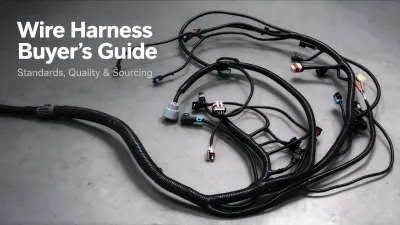
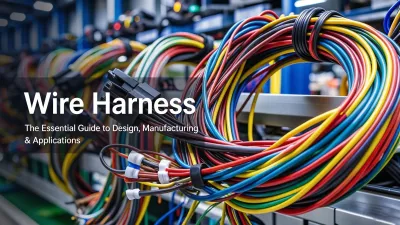
Cars are the most demanding volume environment for wire harnesses: years of vibration and thermal cycling, safety-critical circuits, production schedules measured in minutes, and quality systems that audit everything. A custom harness for a car program is therefore judged on its manufacturing system as much as its build quality. This guide explains what automotive-grade custom assembly involves and how to evaluate suppliers against it.
Materials: Specified, Certified, Traceable
Automotive programs start from material specifications, not catalog picks: wire to defined standards with per-lot certificates, terminals matched to strand class, connector systems to part number, and heat/fluid/abrasion performance matched to vehicle zones. Every material lot is traceable to shipped assemblies — the capability that turns a field failure into a bounded investigation instead of a recall-sized question mark.
Process: Consistency by Control, Not by Inspection
The automotive-grade process chain: automated cut-strip-crimp with per-setup crimp height verification, force-monitored crimp presses where the program requires it, pull-force sampling per shift, in-process checks at defined stations, form-board routing for loom geometry, and 100% electrical test with results recorded per serial or lot. These controls exist because crimp defects — the dominant harness failure mode — are invisible in finished assemblies; only process data proves their absence. Our connector detection analysis explains the failure physics behind the controls.
Documentation: The Part Customers Don't See
Automotive customers receive documentation as part of the product: first-article reports, control plans, capability data for critical characteristics, PPAP-style submissions where required, and revision-controlled drawings with change control — no material or process substitution without written approval. A supplier without this system cannot support a car program regardless of bench quality, because the program's audits will find the gap.
The Custom Dimension: Design Support
Custom car programs also need the supplier's engineering input: voltage-drop and derating calculations, zone-appropriate material selection, sealing strategy for wet circuits, and DFM feedback that reduces cost without touching reliability. The best programs treat the harness supplier as a design partner from the schematic stage — our custom automotive harness guide covers the design phase in depth.
Evaluating a Supplier: The Short Checklist
- Ask for a sample first-article package and a crimp-height record sheet.
- Ask which tests run on 100% of assemblies and which are sampled.
- Ask how a material substitution request is handled — the answer reveals the change-control culture.
- Ask for the traceability chain from a shipped lot back to materials.
Kaweei manufactures custom car harnesses with the full automotive documentation chain from our Dongguan facility, serving module makers, EV startups and Tier suppliers. Contact our engineering team with your program requirements.