Three-pin XLR connectors are widely used to connect microphones, mixing consoles, preamps, and other professional audio equipment. Their continued use reflects the practical advantages of a locking connection and their compatibility with balanced analog audio systems. This guide covers both the connector and the cable.
Balanced Audio and XLR Signal Transmission
XLR is a connector type, not balanced audio itself — it also carries DMX lighting control and other signals. In a typical three-pin balanced analog audio connection, pins 2 and 3 carry the audio signal, while pin 1 connects to the cable shield. The receiving circuit responds to the voltage difference between the two signal conductors. When external interference couples similarly into both conductors, a balanced input can reject much of this common-mode noise. The actual noise rejection depends on the balance of the cable and the connected equipment, as well as the receiver's common-mode rejection performance. Balanced signaling is one reason live sound systems can place microphones and consoles far apart in electrically noisy environments. Our EMC guide covers the same principles in industrial form.
XLR Cable Construction
Conductors
Balanced analog XLR cables typically use two insulated stranded-copper conductors arranged as a twisted pair. Twisting equalizes noise pickup and keeps the electrical geometry stable along the run. The appropriate conductor gauge depends on the cable design, run length, mechanical requirements, and connector termination limits.
Shield
Common shielding options include braided copper, spiral-wrapped copper, and foil with a drain wire. Braided shields generally offer good mechanical durability and a low-resistance shield path, making them suitable for cables that are frequently handled. Foil shields provide high coverage and may suit fixed installations, while spiral shields offer flexibility for certain portable designs. Shielding performance depends not only on the shield type but also on coverage, material, termination, and the design of the whole connection system, so the appropriate construction should be selected against the required shielding performance, flex life, and installation environment.
Jacket
Flexible PVC or rubber compounds form the outer jacket. Audio cable is coiled, stepped on and re-coiled in daily use, so flexibility and abrasion resistance matter.
Connectors
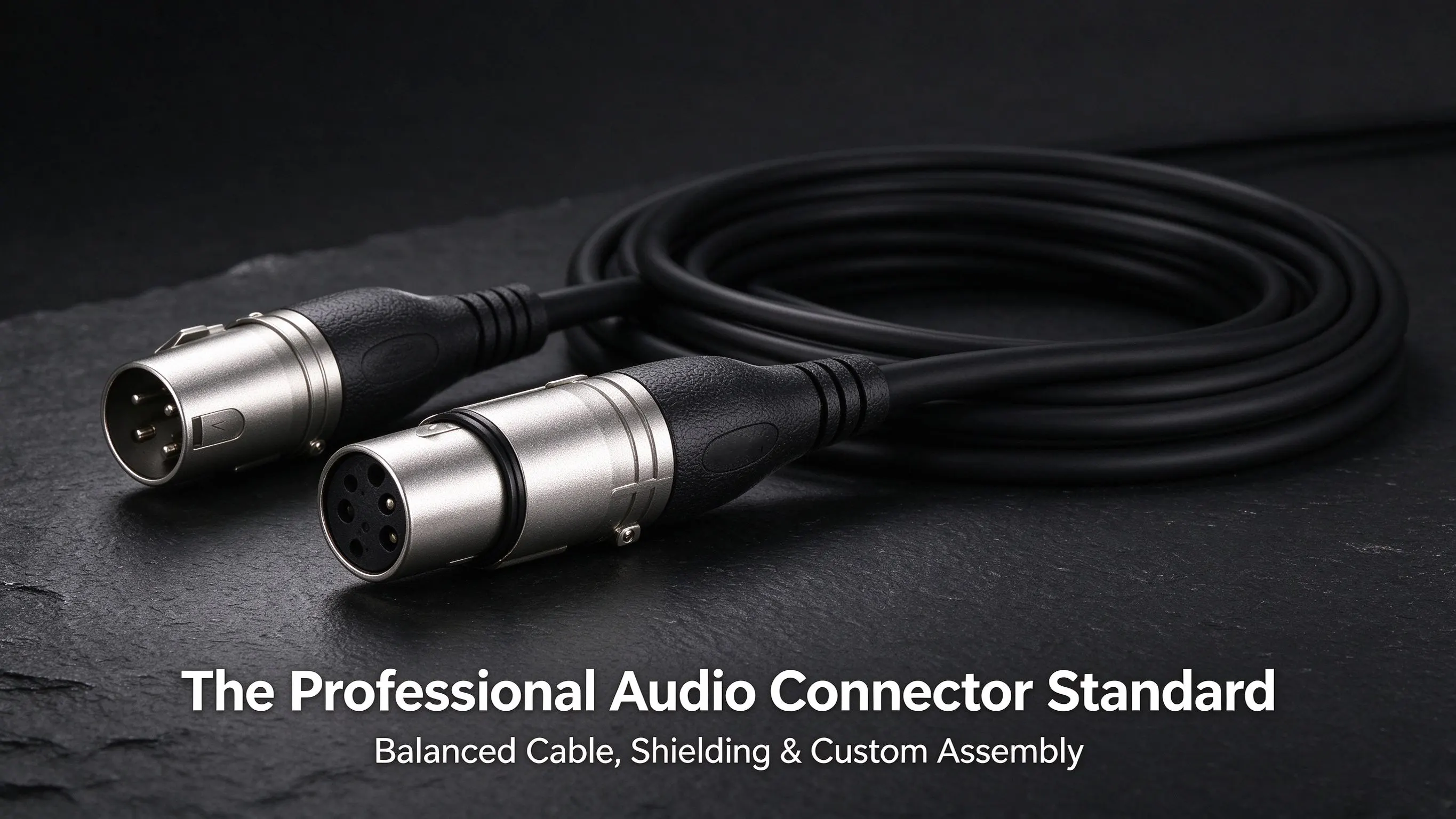
XLR plugs use solder or IDC-style terminations. Metal or engineered-polymer housings, locking mechanisms, and cable strain relief are selected according to the connector design and application requirements. The latch helps prevent accidental disconnection during live use, and the strain relief keeps the cable-to-contact junction from fatiguing.
Quality Markers
When selecting or inspecting XLR cables, check the following points:
- Conductor continuity and correct pin assignment
- Shield continuity and termination
- Solder joint quality and insulation condition
- Cable jacket condition and strain relief
- Locking latch and connector retention
The XLR Family
The connectors below belong to the same connector family, but pin count, mating compatibility and electrical assignments vary. Select for the intended application rather than by appearance or pin count alone.
XLR3
The common three-pin balanced analog audio connector used across professional audio equipment.
XLR4
Used in some intercom headsets and equipment-specific power connections. Pin assignments and electrical ratings must be verified for the intended device.
XLR5
DMX512 lighting control commonly uses five-pin XLR under the applicable standard, though some equipment and systems use three-pin XLR. Compatibility cannot be judged by pin count alone — verify the device and the applicable specification before specifying a connector. Five-pin XLR may also appear in certain equipment-specific audio applications, where pin assignments must be verified.
Selection Notes
Studio
Braid-shielded cable with quality connectors, and lengths appropriate to the run. Balanced signals are designed to run long without issue — that is the point of the architecture.
Live Sound
Road-grade jackets, overmolded strain reliefs, and latches built to survive rough handling and foot traffic.
DMX Lighting
Use cable designed for DMX512 data transmission. DMX512 cable is commonly specified with a nominal characteristic impedance in the region of 120 Ω, and attention is also paid to cable capacitance and termination; ESTA technical guidance explains how characteristic-impedance matching and termination resistors reduce signal reflections. Standard analog audio cable may work in some short or less demanding setups, but it should not automatically be treated as a substitute for cable designed for DMX data transmission. Check the cable specifications and installation requirements for the intended system.
Fixed Installation
Plenum-rated jackets where codes require them, and neat, durable terminations at panels.
The following table summarizes the key cable considerations and inspection checks by application.
|
Application
|
Key cable considerations
|
Important checks
|
|---|---|---|
|
Studio microphone
|
Flexible twisted pair, suitable shielding
|
Pin assignment, shield continuity, connector fit
|
|
Live sound
|
Flexible jacket, durable strain relief
|
Flex durability, latch retention, visual inspection
|
|
DMX512 lighting
|
Cable designed for the required data transmission characteristics
|
Characteristic impedance, cable capacitance, termination
|
|
Fixed installation
|
Suitable jacket rating and installation construction
|
Applicable building codes, termination and labeling
|
|
Custom equipment wiring
|
Connector configuration and electrical requirements defined by the equipment
|
Approved drawing, pin mapping, length tolerance
|
Frequently Asked Questions
What is an XLR cable used for?
XLR cables are commonly used to connect microphones, mixers, audio interfaces, amplifiers, and other professional audio equipment. Three-pin XLR cables are widely used for balanced analog audio signals, while other XLR configurations serve specific applications such as intercom systems and lighting control.
What is the difference between a balanced and an unbalanced XLR connection?
A typical balanced audio connection uses two signal conductors to carry opposite-polarity signals, with a shield providing protection against electromagnetic interference. A balanced receiver detects the difference between the two signals and can reject noise that affects both conductors similarly. However, using an XLR connector alone does not guarantee a balanced signal path.
What do pins 1, 2, and 3 mean on a standard three-pin XLR connector?
For a typical balanced analog audio connection, pin 1 connects to the shield, pin 2 carries the positive-polarity signal (hot), and pin 3 carries the negative-polarity signal (cold). Always verify the equipment documentation because pin assignments may differ in specialized applications.
Can I use a standard XLR audio cable for DMX lighting?
A standard audio XLR cable may work in some DMX setups, particularly over short distances, but it is not automatically a suitable substitute for DMX cable. DMX cable should meet the electrical and construction requirements of the intended lighting system, including characteristic impedance. Also verify the connector pin count and applicable DMX512 requirements.
What should I check when choosing a custom XLR cable assembly?
Check the connector type and pin assignment, cable length, conductor construction, shielding, flexibility, jacket material, and operating environment. For custom assemblies, also specify the required electrical tests, shield continuity checks, labeling, and production inspection criteria.
Professional Audio Cable Manufacturing
For a custom XLR cable assembly, share your connector models, cable length, shielding requirements, and annual volume with our team for a manufacturing review. Contact us at wireharnessassembly.com/contact.