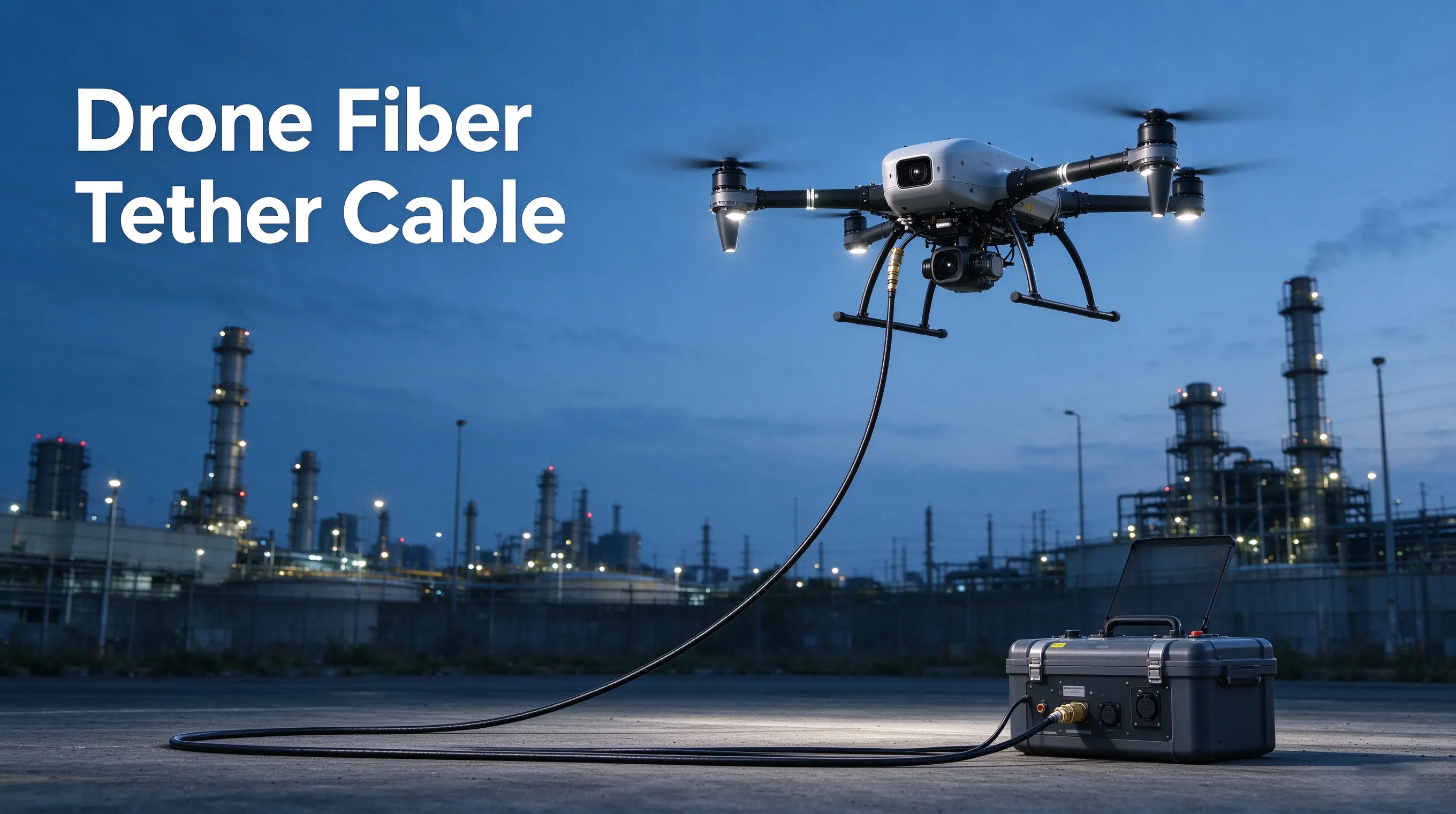
A tethered drone has a different cable requirement from a conventional airborne system. The tether must carry data reliably while adding as little weight and aerodynamic load as possible. In high-EMI environments, conventional RF connections often struggle to maintain stable communication, which creates operational limitations for industrial and emergency drone missions. Fiber optic tether cables address these practical pain points by using optical transmission instead of electrical data transmission. Depending on system design, they deliver high data rates, low optical loss, EMI immunity, and long transmission distances. Hybrid variants further integrate copper power conductors to support continuous ground power supply for extended drone operation.
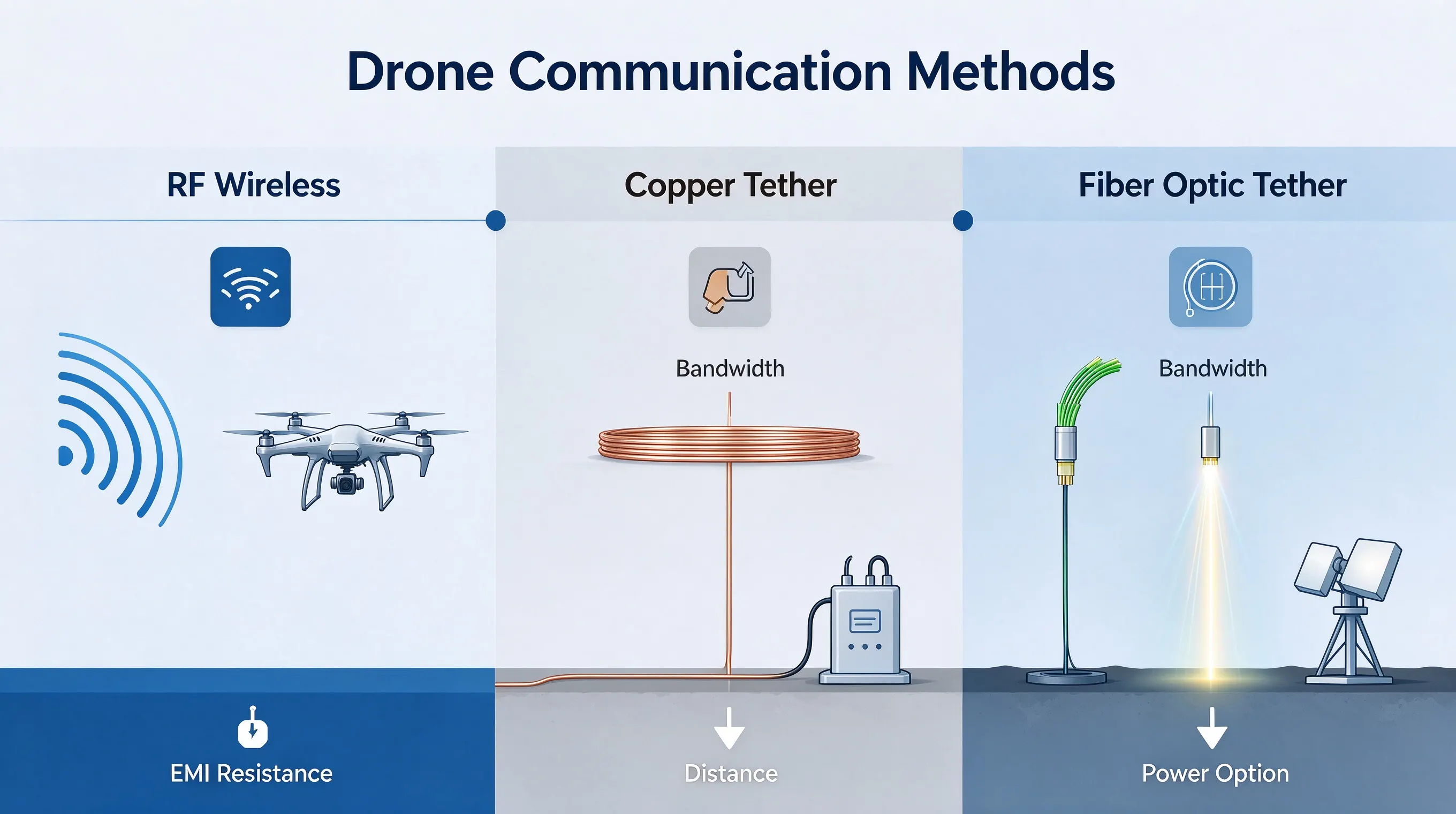
1. Fiber Optic vs. RF and Copper Drone Communication
RF wireless and copper-based tether solutions remain practical for many drone applications, while professional systems may require higher bandwidth, longer transmission distances, stronger EMI resistance, or extended-duration operation. Fiber optic tethering is not suitable for every drone system. Its main advantages become relevant when bandwidth, EMI resistance, transmission distance, or tethered operating time are key design requirements. The following comparison outlines core operational differences between the three common drone communication architectures:
|
Parameter
|
RF Wireless
|
Copper Tether
|
Fiber Optic Tether
|
|
EMI Resistance
|
Limited (vulnerable to field interference and spectrum noise)
|
Moderate/Low (prone to electromagnetic crosstalk and noise)
|
Excellent (optical fiber is inherently immune to EMI)
|
|
RF Radiation
|
Yes (wireless broadcast signals are detectable)
|
No
|
No RF signal is radiated by the fiber itself
|
|
Data Bandwidth
|
Low to medium (restricted by licensed/unlicensed spectrum limits)
|
Medium to high, depending on conductor design, cable length, shielding, and transmission protocol
|
Very high (supports multi-stream HD video and sensor payloads)
|
|
Transmission Distance
|
Variable; affected by frequency, antenna configuration, transmit power, terrain, and interference
|
Short to medium (signal degradation increases with length)
|
Long-range capable (optimized for extended aerial tethered operation)
|
|
Cable Weight
|
No physical tether required
|
High (heavy copper conductors increase drone payload burden)
|
Low (lightweight construction minimizes flight load)
|
|
Physical Tether Required
|
No
|
Yes
|
Yes
|
|
Power Transmission Support
|
No
|
Yes (integrated power and signal delivery)
|
No (standard fiber; power available via hybrid cable customization)
|
|
Typical Use Case
|
Untethered flight, general telemetry, video links
|
Power delivery and electrical data transmission in tethered systems
|
Industrial tethered drones, surveying, high-precision inspection
|
2. Types of Fiber Optic Cables for Drones
Drone optical tether cables are classified by fiber specification, structural reinforcement, and functional configuration. Matching the correct cable type to mission requirements ensures reliable transmission, mechanical durability, and consistent performance across varying flight conditions and payload setups.
1. Single-Mode Fiber Tether
Single-mode fiber tethers feature a compact core structure built for low optical attenuation over long distances. This fiber type is widely used for outdoor long-range inspection, aerial surveying, and remote monitoring missions that demand consistent signal performance across extended flight radii. When paired with compatible transceivers and calibrated optical power budgets, single-mode fiber maintains steady data transmission with minimal signal loss at long tether lengths.
2. Multimode Fiber Tether
Multimode fiber has a larger core and is generally used over shorter distances. It can be a practical choice for indoor facilities or other applications where tether length is limited, especially when compatible multimode transceivers are already part of the existing system setup. This option delivers adequate throughput for close-quarters professional drone operations at a lower system cost.
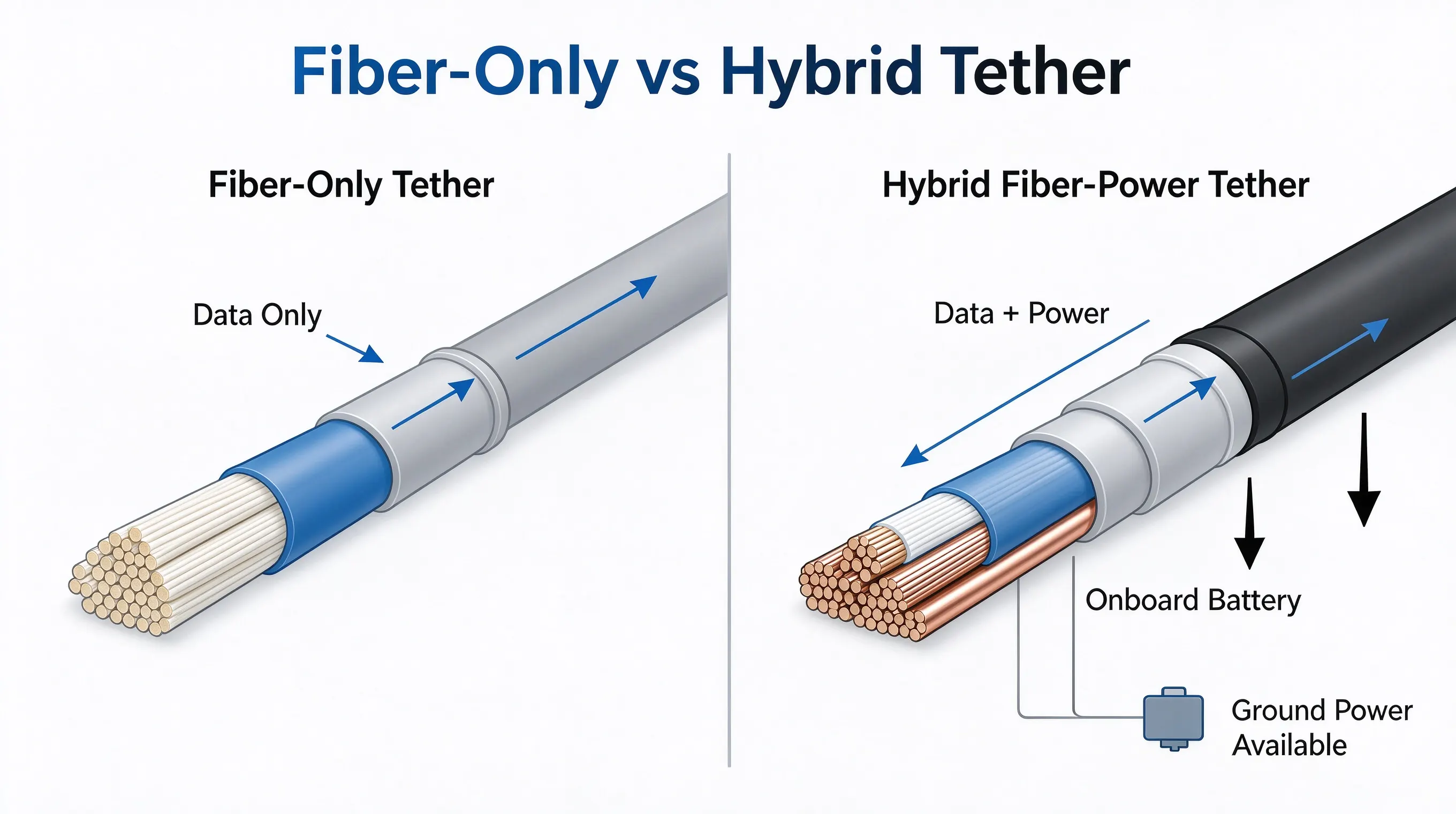
3. Fiber-Only Tether
In a fiber-only tether, the cable carries optical data but no electrical power. The simpler construction keeps cable mass and diameter low, reducing airborne weight and aerodynamic drag. This design fits short-to-medium-duration missions that rely on the drone’s onboard battery, supporting core functions like flight telemetry, high-definition video streaming, and multi-sensor data collection.
4. Hybrid Fiber-Power Tether
A hybrid tether adds insulated copper conductors to the optical fiber core, enabling a single cable to handle both high-speed optical data transmission and continuous ground power delivery. This integrated design reduces reliance on drone onboard batteries, supporting extended hovering and fixed-point monitoring when stable ground power is available. It combines the EMI resistance of optical data links with hardwired power supply for long-cycle field operations.
5. Reinforced High-Strength Fiber Tether
For airborne tethers, tensile loading and repeated bending stress are far more frequent than in fixed ground cable installations. Reinforced drone fiber tethers integrate aramid strength members to boost tensile resilience, bending tolerance, and abrasion resistance. The enhanced mechanical structure withstands wind fluctuations and continuous tension cycling, preserving cable integrity during long-duration tethered operation.
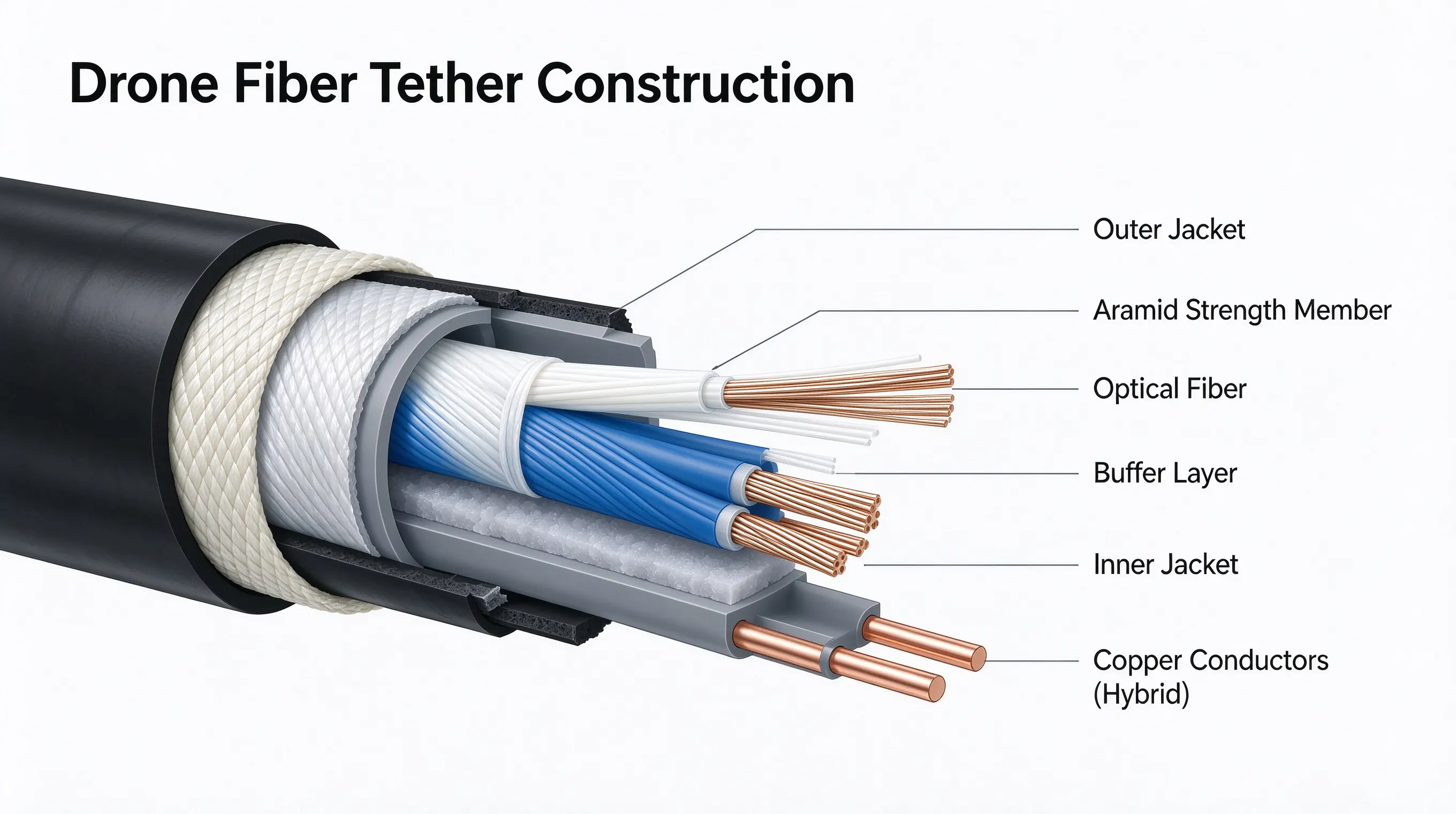
3. Drone Fiber Optic Cable Construction
Professional drone fiber tethers adopt a layered composite structure to balance data transmission performance, mechanical toughness, and environmental adaptability. The main construction layers and their functions are shown below.
|
Component
|
Core Function
|
|
Optical Fiber
|
Transmits high-speed optical data signals for video streaming, sensor telemetry, and flight control communication
|
|
Fiber Coating and Buffer Layers
|
Shields bare optical fiber from micro-bending, surface friction, and minor mechanical stress
|
|
Aramid Strength Member
|
Delivers primary tensile reinforcement to withstand aerial tension and wind-induced mechanical load cycling
|
|
Inner Jacket
|
Isolates internal components, reduces inter-layer friction, and improves structural stability
|
|
Outer Jacket
|
Provides external protection against abrasion, moisture, UV exposure, and variable ambient temperatures
|
|
Connector Assembly
|
Establishes a stable physical and optical interface between the tether, airborne hardware, and ground control station
|
|
Copper Conductors (Hybrid Only)
|
Enables continuous low-voltage power transfer from ground infrastructure to tethered drone platforms
|
4. Key Benefits of Fiber Optic Drone Tether Cables
1. High-Bandwidth Data Transmission for Multi-Payload Operation
Drone payloads can include 4K/8K cameras, thermal cameras, LiDAR, and multiple environmental sensors. The required data rate varies based on the number of streaming channels, video compression standards, sensor output volume, and communication protocols in use. Fiber-based links can support data rates from hundreds of Mbps to multi-Gigabit Ethernet and beyond when the fiber type, transceivers, connectors, and network architecture are properly matched to mission requirements.
2. Low Propagation Delay for Responsive Flight Control
Optical tether cables produce minimal signal propagation delay, enabling precise, real-time flight telemetry and payload control. Cable-level delay differs from full-system latency; end-to-end response time depends on the complete signal chain, including cameras, encoders, transceivers, processing hardware, and transmission distance. In applications where EMI resistance, high data capacity, and a physically controlled transmission medium are priorities, fiber delivers a more consistent communication path than RF wireless links. This helps maintain responsive video feedback and control communication during dynamic aerial operations.
3. Native EMI Immunity and Reduced RF Exposure
Unlike copper tethers that transmit electrical signals, optical drone tethers carry data via light through a dielectric glass core. The fiber medium itself resists electromagnetic interference and emits no RF signals during operation, making optical links well-suited for high-EMI environments such as power substations, industrial facilities, and dense urban electromagnetic fields. Because optical transmission does not radiate RF energy from the cable medium, it can reduce exposure to conventional RF interception methods and improves overall mission data stability.
4. Lightweight, Flexible Construction for Airborne Use
Compared with copper tethers of equivalent mechanical strength, optical drone tethers reduce overall airborne weight. A typical lightweight construction combines small-diameter optical fiber with an aramid strength member and a thin protective jacket. This structure tolerates repeated bending, wind-induced tension changes, and field abrasion, maintaining structural integrity throughout long drone deployments.
5. Stable Long-Distance Transmission Capability
Fiber generally provides lower attenuation than copper over long transmission distances. Copper tether cables suffer from gradual signal degradation as length increases, limiting operational radius. Actual maximum tether distance for fiber systems still depends on fiber type, transceiver sensitivity, connector quality, and the available optical power budget.
5. Key Design Parameters for Drone Fiber Optic Cables
Drone fiber optic tethers are application-specific engineered solutions rather than generic off-the-shelf cables. All core specifications can be customized to accommodate unique drone flight dynamics, payload configurations, and mechanical stress profiles. As a manufacturer of custom drone wire harnesses and optical tether cables, we tailor designs around the following key engineering and procurement parameters:
-
Fiber Type: Single-mode fiber for low-attenuation, long-range aerial transmission; multimode fiber for cost-effective, high-bandwidth short-range industrial and indoor operations, selected based on project-specific distance and throughput requirements.
-
Fiber Count: Single-fiber and multi-fiber configurations available for customization, matching required data channel counts and connector architecture to support parallel video and sensor transmission workflows.
-
Tensile Strength: Aramid fiber strength members, including Kevlar-type reinforcement where applicable, deliver customizable tensile ratings to withstand sustained aerial suspension, wind gust loading, and incidental ground friction during field operation.
-
Minimum Bend Radius: Low-bend optimized fiber construction tolerates frequent in-flight bending and routine coiling, reducing micro-bend signal loss and fiber fatigue risk.
-
Outer Diameter: Slim, customizable cable profiles reduce aerodynamic drag and dead weight, aligning with individual drone payload limits and internal assembly constraints.
-
Jacket Material: Industrial-grade TPU, LSZH, and PE jacket options with custom compound formulations deliver enhanced abrasion resistance, tear strength, and outdoor aging stability.
-
Operating Temperature Range: Thermal performance customizable via selected fiber coatings, buffer layers, jacket compounds, and connector hardware to suit variable environmental conditions.
-
Connector Type: LC, SC, ST, MPO/MTP, and application-specific ruggedized connectors can be selected according to optical interface, vibration, sealing, mating cycles, and environmental requirements.
-
Transmission Performance: Specify the required data rate, insertion loss, return loss, and optical power budget according to the selected fiber and transceiver system.
6. Fiber-Only vs. Hybrid Fiber-Power Tether Cables
Choosing between fiber-only and hybrid fiber-power tether designs is a critical system integration decision, as each configuration serves distinct operational use cases and addresses unique endurance and power constraints for professional drone deployments.
1. Fiber-Only Tether Cables
Choose a fiber-only tether when minimizing airborne mass and reducing flight load is a higher priority than continuous ground power supply. Fiber-only tethers carry exclusively optical data signals without integrated power conductors. Their ultra-light, low-drag profile suits short-to-medium-duration missions dependent on onboard drone battery power. These tethers handle all primary data workflows, including flight control telemetry, high-definition video monitoring, and multi-sensor data logging, making them well-suited for lightweight drone platforms with strict payload limitations.
2. Hybrid Fiber-Power Tether Cables
Select a hybrid fiber-power tether for long-duration operational scenarios that require both stable data transmission and continuous ground power support. This design integrates optical fiber cores and insulated copper power conductors in a single outer jacket, enabling simultaneous data and power delivery. It reduces reliance on drone onboard batteries and supports extended hovering and fixed-point monitoring, making it suitable for industrial inspection, emergency response, and other long-cycle field tasks.
7. Applications of Fiber Optic Drone Cables
1. Infrastructure & Industrial Inspection
Tethered drones equipped with optical fiber tethers can support critical infrastructure inspection workflows, including power line patrolling, wind turbine blade auditing, petrochemical pipeline monitoring, and high-rise structural safety assessments. The high-bandwidth, low-loss transmission profile supports stable real-time 4K/8K video streaming, allowing engineering teams to identify surface cracks, corrosion, loose hardware, and other visible structural defects.
2. Emergency Response & Disaster Relief
Disaster zones such as collapsed structures, landslide sites, and flood-affected areas often feature blocked or degraded RF wireless coverage. Drone optical tether systems provide a stable physical data link with low RF interference susceptibility, supplying real-time site information to support rescue coordination, survivor localization, and post-event damage assessment. The wired optical link works reliably in RF-congested or communication-challenged environments.
3. Mapping & Surveying
Aerial mapping and geodetic survey drones generate large volumes of LiDAR point cloud data and high-resolution panoramic imagery. These datasets require reliable high-throughput transmission to avoid data loss or frame interruption during collection. Optical drone cables support continuous high-volume data transfer for field survey and mapping workflows.
4. Security & Defense
RF spectrum congestion and signal interference are common issues in complex operational environments. Fiber-tethered drone systems produce no RF radiation and resist electromagnetic disruption, enabling steady real-time video surveillance and situational data sharing. The low-signature, physically tethered transmission link is well-suited for security monitoring and perimeter surveillance applications.
5. Industrial Environmental Monitoring
Industrial sites—including factories, ports, and underground mines—can contain significant electromagnetic noise from motors, drives, and other mechanical equipment. Optical communication avoids electrical signal coupling in the fiber itself, making it suitable for drone-based environmental monitoring and equipment inspection in these high-interference conditions.
8. How to Select a Fiber Optic Cable for a Drone
Proper cable selection directly impacts tethered drone system stability, service lifespan, and mission capability. Based on application requirements and manufacturing experience, the following structured selection framework helps specify appropriate optical tether solutions for professional drone deployments:
-
Confirm transmission distance: Select single-mode fiber for longer transmission distances where low attenuation is important, after confirming transceiver compatibility and the available optical power budget. Use multimode fiber for shorter-distance systems designed around compatible multimode transceivers.
-
Match required bandwidth: Specify cable bandwidth based on onboard payload requirements, including camera resolution, sensor count, and concurrent streaming channel volume to avoid data throughput bottlenecks.
-
Define mechanical requirements: Customize tensile strength and minimum bend radius based on flight dynamics, typical wind loading, and on-site abrasion conditions.
-
Select suitable jacket material: Deploy LSZH flame-retardant jackets for indoor and fire-sensitive environments; use high-toughness TPU jackets for outdoor, high-wear, and extreme-temperature field applications.
-
Specify connector grade: Integrate industrial-grade waterproof, anti-vibration connectors matched to drone and ground station interface standards for long-term connection stability.
-
Determine power configuration: Specify hybrid fiber-power tethers for long-cycle continuous-duration operations; deploy lightweight fiber-only cables for short-endurance, payload-sensitive missions.
-
Verify environmental compatibility: Tailor thermal resilience, moisture resistance, and UV stability to match high-altitude, desert, coastal, or industrial workshop operating conditions.
9. Custom Drone Fiber Optic Cable Manufacturing Advantages
Drone fiber tethers require different mechanical and optical specifications than standard communication cables, due to repeated bending, variable tension, and airborne weight limits. We customize fiber count, cable diameter, tensile reinforcement, jacket material, connector configuration, and hybrid power integration to match specific drone platforms and operating environments.
Custom designs accommodate long transmission distances, wide temperature cycling, high mechanical stress, and low RF exposure requirements. All finished cable assemblies undergo standard performance validation, including tensile cycling, repeated bending, thermal aging, and optical attenuation testing to ensure consistent field performance.
Compared with generic off-the-shelf cables, application-specific designs allow cable dimensions, tensile reinforcement, connector configuration, and environmental protection to be matched to the actual drone platform and operating conditions.
10. FAQ About Drone Fiber Optic Cables
1. Are fiber optic drone cables fully immune to all field interference?
The optical fiber itself is inherently immune to EMI and does not radiate RF signals. However, the complete drone communication system—including connectors, transceivers, power electronics, and onboard processing hardware—may still be affected by intense electromagnetic field activity in complex operational environments.
2. What is the core difference between fiber-only and hybrid drone tethers?
Fiber-only tethers are lightweight, data-dedicated cables optimized for battery-powered short-endurance drone flights. Hybrid fiber-power tethers integrate optical and copper conductors to enable continuous ground power delivery, supporting extended-duration hovering and long-cycle field monitoring tasks.
3. Which fiber type is best for tethered drone systems?
Single-mode fiber is often preferred for outdoor long-distance applications requiring low signal attenuation. Multimode fiber provides cost-effective high-bandwidth performance for short-range indoor industrial monitoring and close-quarters operational scenarios.
4. Do fiber optic tethers reduce drone flight endurance?
Professionally customized drone fiber cables are lighter than equivalent-performance copper tethers, reducing overall cable mass. Depending on cable diameter and tether geometry, these designs may also lower aerodynamic drag. For hybrid tether systems, continuous ground power reduces reliance on onboard batteries, extending effective operational duration for tethered missions.
5. Can fiber optic cables carry power to a drone?
Standard optical fiber carries data, not electrical power. If the drone requires continuous power from the ground station, a hybrid fiber-power tether with integrated copper conductors is required to support simultaneous data transmission and ground power delivery.
6. How far can a fiber optic drone tether transmit data?
Transmission distance depends on fiber type, transceiver specifications, connector loss, splice loss, and the available optical power budget. Single-mode fiber is generally selected for longer-distance systems requiring low signal attenuation, while multimode fiber is typically used for shorter-distance applications paired with compatible multimode transceivers.
11. Conclusion
Fiber optic tether cables are useful when a drone system requires high data capacity, EMI immunity, low optical attenuation, or long transmission distances. Fiber-only and hybrid designs serve distinct power and weight requirements, while cable construction must be tailored to tensile load, bending limits, environmental conditions, and connector compatibility.
For custom drone tether projects, these core parameters should be defined alongside the drone platform, payload configuration, ground station specifications, and expected operating environment to achieve reliable, mission-matched system performance.