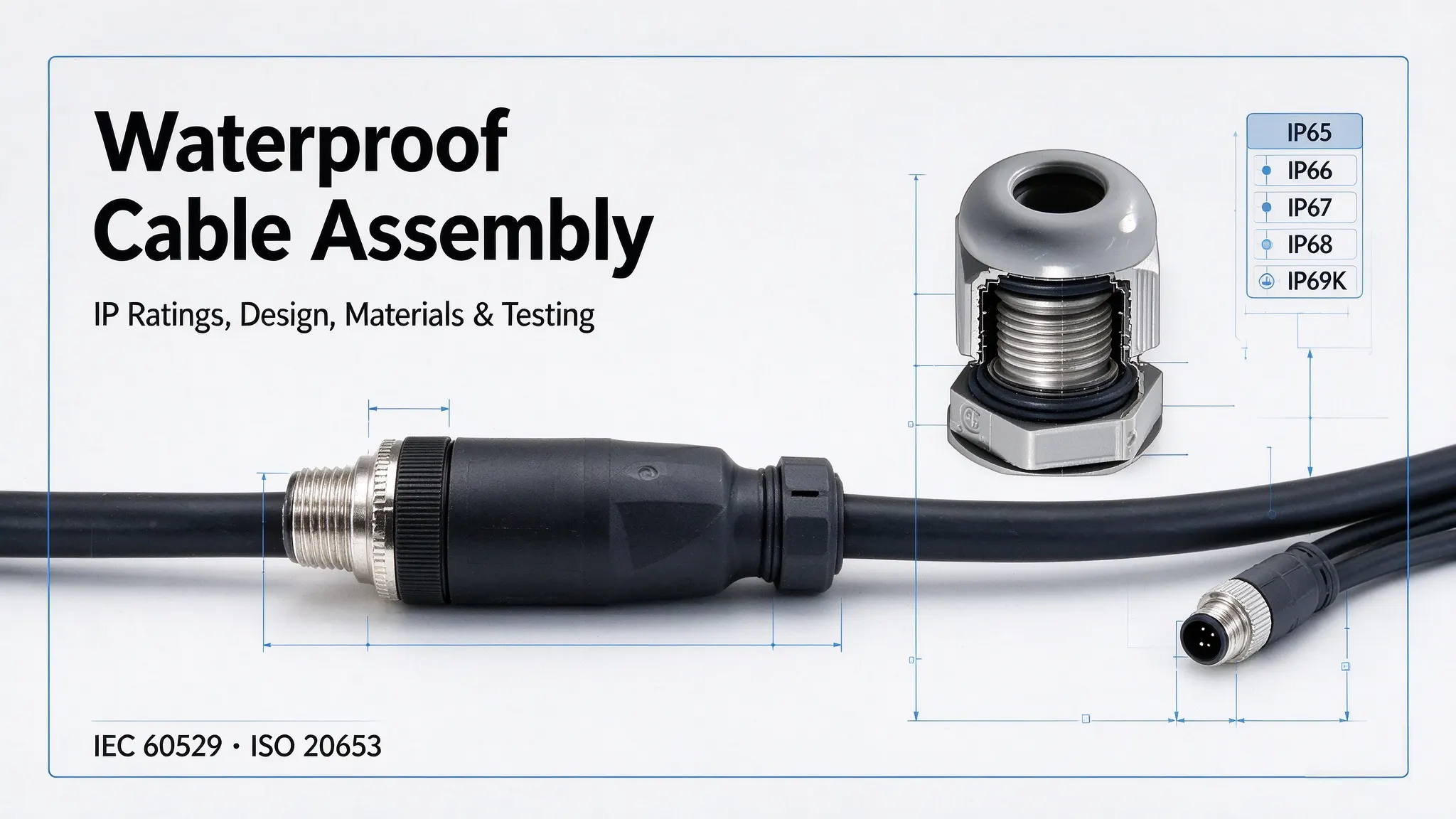
Waterproof cable assemblies are critical wiring components for industrial automation, automotive systems, marine equipment, and outdoor smart devices, delivering stable power and signal transmission in humid, dusty, splash-prone, and submerged environments. As senior engineers specializing in custom wire harness manufacturing, we find most field failures stem from misapplied IP ratings, mismatched materials, incomplete sealing design, and non-compliant testing rather than pure production defects.
This engineering-focused guide follows the latest IEC 60529:1989+A1:1999+A2:2013 consolidated standard and ISO 20653:2023 road vehicle IP specification. It delivers accurate IP rating definitions, practical waterproof design principles, application-based material selection rules, and standardized testing workflows, helping design engineers and procurement teams specify reliable, cost-effective custom waterproof cable assemblies and avoid common technical pitfalls.
1. What Is a Waterproof Cable Assembly?
A waterproof cable assembly is a cable or group of insulated conductors terminated with connectors, terminals, seals, and other protective components designed to limit water and dust ingress under specified environmental conditions. Depending on its architecture, it may also incorporate wire-harness features such as branches, protective sleeving, and multiple connectors.
These assemblies are widely customized for outdoor exposure, high-pressure washing, temporary immersion, long-term submergence, and corrosive industrial scenarios, with protection levels fully compliant with international IP rating standards.
2. Understanding IP Ratings for Waterproof Cable Assemblies
The IP (Ingress Protection) code, defined by the consolidated IEC 60529:1989+A1:1999+A2:2013 standard, classifies the degree of protection provided by electrical enclosures against access, solid foreign objects, dust and water. The first digit indicates solid particle and dust protection, while the second digit indicates liquid water protection. For many outdoor and industrial applications, IP6X is commonly specified when complete dust-tightness is required. However, the appropriate first digit should be selected according to the actual environmental requirements.
Notably, IP69K/IPX9K for road vehicle applications follows ISO 20653:2023, which covers specialized high-temperature and high-pressure washdown requirements not fully defined in the basic IEC 60529 standard.
|
IP Rating
|
Standard Protection Definition
|
Typical Application Scenarios
|
Engineering Customization Notes
|
|---|---|---|---|
|
IP65
|
Dust-tight; protected against water jets from any direction per IEC 60529
|
Outdoor lighting, general industrial equipment, outdoor monitoring devices
|
Suitable for rain splash and routine surface cleaning; not designed for water immersion
|
|
IP66
|
Dust-tight; protected against powerful water jets from any direction per IEC 60529
|
Factory workshop machinery, roadside traffic facilities, construction equipment
|
Enhanced jet resistance for frequent high-pressure water washing environments
|
|
IP67
|
Dust-tight; protected against temporary immersion. Standard test condition: 1-meter water depth for 30 minutes
|
Smart outdoor devices, automotive exterior wiring, portable industrial equipment
|
Cost-effective mainstream grade for outdoor use; defined for temporary immersion test conditions only
|
|
IP68
|
Dust-tight; protected against continuous immersion under conditions specified for the product and agreed between the manufacturer and user per IEC 60529. Exact depth, duration, temperature, pressure and test arrangement must be explicitly defined for each application.
|
Marine equipment, underwater sensors, deep-well detection, submersible communication devices
|
No universal fixed depth/duration standard; specify immersion depth, duration, temperature, and pressure per actual working conditions
|
|
IPX9K / IP69K (automotive-specific)
|
Dust-tight; specialized high-temperature, high-pressure water-jet washdown protection for road vehicles. Terminology and test criteria follow ISO 20653:2023, which defines vehicle-specific K-grade requirements not covered by the general IEC 60529 standard.
|
Food & pharmaceutical processing machinery, heavy-duty industrial vehicles, automotive chassis wiring
|
Test conditions are standardized for road vehicles via ISO 20653; do not treat IP69K as a universal IEC 60529 water resistance rating. Designed exclusively for extreme high-pressure hot water washdown scenarios.
|
3. IP65 vs IP66 vs IP67 vs IP68: Key Technical Differences
A critical engineering misconception is assuming higher IP water ratings automatically cover lower-grade water protection tests. The second IP digit represents independent test criteria, with no cross-coverage by default:
-
IPX5: All-direction water jet protection
-
IPX6: All-direction powerful water jet protection
-
IPX7: Controlled temporary immersion protection
-
IPX8: Custom continuous immersion protection
Key Rule: IP67 and IP68 immersion ratings do not inherently satisfy IP65/IP66 water jet protection requirements. However, products may be qualified to multiple combined ratings (such as IP66/IP68) to demonstrate compliance with both powerful water jet exposure and continuous immersion conditions, based on targeted standardized testing.
4. How to Design a Reliable Waterproof Cable Assembly
Waterproof failure points of cable assemblies are concentrated in cable entry ports, connector interfaces, crimp terminals, splicing joints, and strain relief positions. Professional waterproof design eliminates leakage paths through standardized structural solutions instead of redundant stacking sealing structures.
4.1 Connector Sealing & Interface Protection
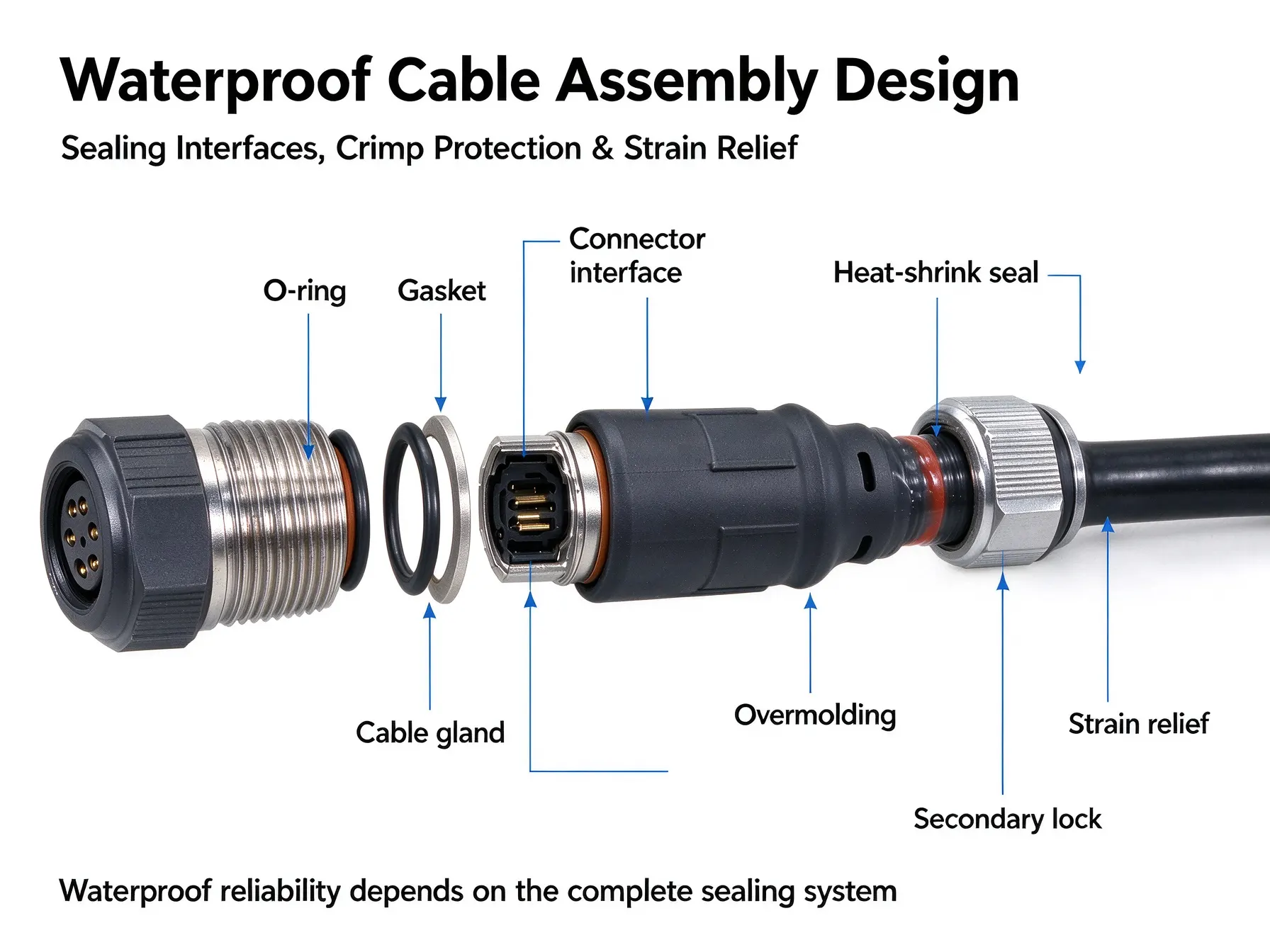
Connector waterproof performance relies on precision mating interfaces and professional sealing components. O-rings and gaskets provide reliable sealing at mating gaps, while secondary locking or position-assurance mechanisms (TPA/CPA) prevent terminal displacement and connector separation under long-term vibration, maintaining long-term mechanical integrity and consistent sealing performance under dynamic working conditions.
4.2 Cable Entry & Strain Relief Structure
Cable outlet leakage is one of the most common failure causes. Standard engineering solutions include integrated overmolding, compression cable glands, and flexible strain relief structures. These designs lock the cable sheath tightly while resisting tensile and bending forces, reducing potential water-ingress paths and limiting capillary moisture migration through loose structural gaps.
4.3 Crimp & Splice Point Sealing
Exposed crimp terminals and splice joints are highly susceptible to oxidation and moisture ingress. We utilize high-temperature waterproof heat-shrink tubing, sealing compounds, and professional potting/encapsulation processes to protect exposed conductive areas from moisture, contamination and corrosion, minimizing moisture-related corrosion and electrical failure risks in humid working environments.
4.4 Environmental & Pressure Adaptation Optimization
For deep-immersion and pressure-cycling applications, sealing structures are evaluated against hydrostatic pressure, cable movement, and internal moisture accumulation. Pressure-resistant overmolding and full potting encapsulation are widely adopted to deliver reliable pressure-resistant waterproof performance. In selected low-pressure cycling designs, hydrophobic vent membranes may be integrated for controlled venting, equalizing internal and external pressure while limiting liquid-water ingress to avoid seal stress and condensation buildup. Universal drainage structures are not applied to IP68 products, as they may introduce potential leakage paths.
5. Waterproof Cable & Sealing Material Selection Guide
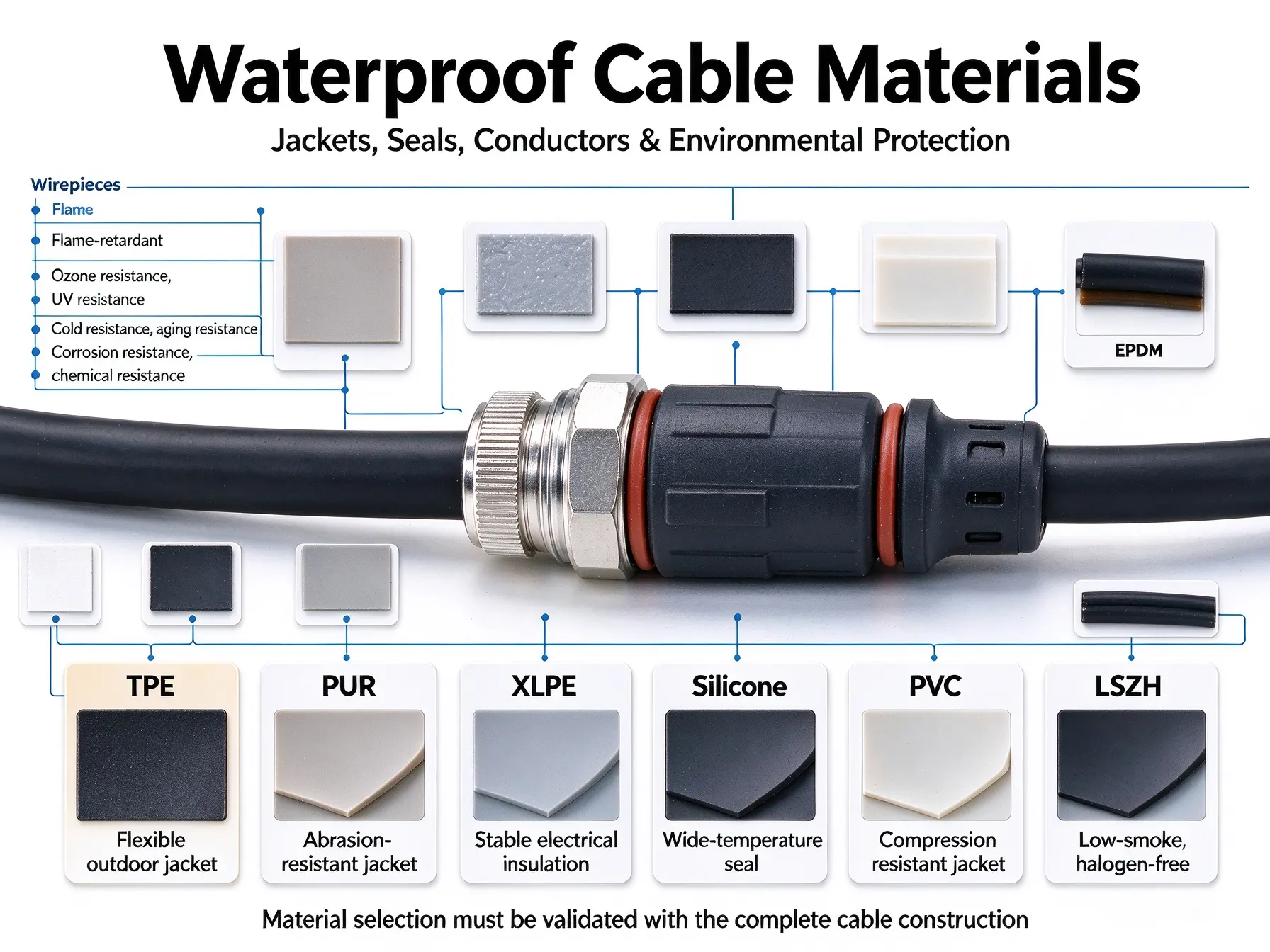
Material performance determines assembly durability, but no single material can define the final IP rating. The overall waterproof capability depends on the combination of cable construction, connectors, seals, processing technology, and testing verification. All materials are selected based on actual environmental working conditions.
5.1 Cable Jacket Materials
UV-stabilized TPE: Cost-effective flexible material with excellent low-temperature resistance and outdoor adaptability. Suitable for conventional IP65/IP67 outdoor waterproof assemblies, with improved resistance against long-term UV radiation and environmental aging cracking.
PUR (Polyurethane): High-tensile, tear-resistant, and wear-resistant material. Ideal for frequently bent and mobile wiring scenarios such as industrial robots and mobile monitoring equipment, balancing flexibility and structural durability.
XLPE (Cross-linked Polyethylene): Features low water absorption, high thermal stability, and stable electrical insulation. It can be considered for applications requiring elevated-temperature performance and reliable insulation. For long-term submerged applications, the complete cable construction, water tree resistance, longitudinal water blocking structure, and overall system sealing must be fully validated, rather than relying solely on XLPE insulation material.
Silicone Rubber: Delivers flexible, high-performance temperature resistance. The actual operating temperature range is determined by the specific silicone compound and cable construction, supporting extreme low and high-temperature environments for specialized waterproof wiring systems, including food and medical-grade applications.
PVC: A cost-effective, general-purpose jacket material for conventional indoor and mild outdoor splash-proof scenarios. Suitability for prolonged immersion, outdoor UV exposure, or severe chemical environments depends entirely on the specific PVC formulation and compliance with applicable cable industry standards.
5.2 Sealing & Auxiliary Materials
EPDM & Silicone Seals: Excellent compression resilience and aging resistance, suitable for long-term static and dynamic sealing in indoor and outdoor environments. Food-grade silicone is applied for sanitary industry equipment.
Conductor Materials: Tinned copper conductors are standard for anti-oxidation and salt spray corrosion resistance in coastal and humid environments; bare copper is used for conventional indoor dry scenarios.
Protective Auxiliaries: Low-smoke zero-halogen (LSZH) materials are adopted for public and industrial safety equipment, delivering low smoke emission and reduced halogen release during combustion to minimize fire hazards and corrosive gas output.
6. Standardized Waterproof Cable Assembly Testing System
We strictly distinguish qualification/type testing (design validation) and production batch testing (finished product inspection) to ensure engineering accuracy and avoid exaggerated technical claims. IP full standard testing is implemented for product certification and new project validation, while standardized electrical and visual inspection is applied for every finished product.
6.1 IP Qualification & Type Testing
Performed for new product design verification, customer qualification, and batch certification, fully compliant with IEC 60529 and ISO 20653 standards:
-
Dust Ingress Testing: Conducted per IP6X standard requirements to verify dust-tight performance in accordance with standardized IP6X test criteria, with test parameters adjusted per product specifications.
-
Water Jet Testing (IP65/IP66): All-directional standard water jet flushing to simulate real-world rain splash and routine equipment high-pressure cleaning scenarios.
-
Immersion Testing (IP67/IP68): IP67 follows 1m/30min standardized immersion; IP68 implements custom depth, duration, and pressure testing per customer project specifications.
-
High-Temperature Washdown Testing (IP69K): Compliant with ISO 20653:2023 road vehicle high-pressure hot water flushing standards.
6.2 Environmental Durability Testing
Includes UV aging, high-low temperature cycling, salt spray corrosion, and bending fatigue tests to evaluate structural and material durability under extreme conditions. Actual service life depends on operating temperature, mechanical load, installation environment, and mating cycles; laboratory test results only verify conditional durability performance.
6.3 Full Production Inspection
Every customized assembly undergoes 100% production testing, including continuity detection, insulation resistance testing, withstand voltage testing, short/open circuit inspection, and dimensional visual inspection, minimizing electrical continuity, insulation, and circuit defects in all delivered assemblies.
7. Common Waterproof Cable Assembly Design & Customization Mistakes
Based on mass customization experience, most on-site failures arise from unreasonable specification confirmation and design negligence, summarized as key avoidance guidelines:
-
Blind high IP grade selection: IP68 customization increases material and process costs significantly. IP65/IP66 fully meet conventional outdoor splash-proof scenarios without over-engineering.
-
Over-reliance on high-grade connectors: A single high-IP connector cannot guarantee overall waterproof performance; cable entry, crimp points, and tail sealing are equally critical failure-prone areas.
-
Mismatched environmental materials: Outdoor UV exposure requires UV-stabilized jackets; coastal scenarios need anti-corrosion conductors; low-temperature environments require flexible crack-resistant materials.
-
Ignoring test standard differences: Confusing IEC 60529 industrial IP standards with ISO 20653 automotive IP69K requirements leads to unqualified vehicle wiring assemblies.
8. How to Specify Custom Waterproof Cable Assemblies (Engineering Checklist)
To obtain accurate, compliant, and cost-effective customized solutions, provide the following key parameters for technical confirmation:
-
Required IP rating (clarify industrial/automotive applicable standards)
-
Cable specifications: Wire gauge, core number, length, jacket material
-
Connector type: M8/M12, circular, automotive, or custom connectors
-
Working conditions: Temperature range, immersion depth/duration (IP68 only)
-
Environmental exposure: UV, salt spray, chemical corrosion, frequent bending/vibration
-
Testing & certification requirements: RoHS, CE, IEC/ISO test reports
-
Production demand: Prototype sampling, small batch, or mass production
9. Custom Waterproof Cable Assembly Manufacturing Capabilities
As a professional wire harness custom factory, we deliver engineering-oriented one-stop solutions from design optimization, material matching, sample proofing to standardized production and test report delivery. All products comply with IEC and ISO international standards, supporting flexible customization for various industrial scenarios.
|
Engineering Requirement
|
Available Custom Options
|
|---|---|
|
Water Protection Grade
|
IP65, IP66, IP67, IP68, IP69K/IPX9K (automotive compliant)
|
|
Cable Jacket Materials
|
TPE, PUR, XLPE, Silicone, PVC, LSZH
|
|
Sealing Solutions
|
O-rings, gaskets, cable glands, heat shrink, potting, overmolding
|
|
Connector Types
|
Circular, automotive, M8/M12, waterproof custom connectors
|
|
Conductor Options
|
Bare copper, tin-plated copper, anti-corrosion specialty conductors
|
|
Testing Services
|
Electrical testing, IP qualification, environmental aging, custom certification
|
|
Production Scale
|
Prototype sampling, small batch trial production, large-scale mass production
|
FAQ (High-Value SEO & Engineering Q&A)
Q1: What is an IP67 waterproof cable assembly?
An IP67 cable assembly is dust-tight and tested per IEC 60529 temporary immersion criteria: 1-meter water depth for 30 minutes, with no harmful water ingress that impairs functional performance. It is the mainstream cost-effective solution for outdoor non-submerged equipment.
Q2: Is IP68 better than IP67 for waterproof cable assemblies?
IP68 specifies continuous immersion test conditions beyond the IP67 temporary immersion standard, but it is not simply a "higher-grade" upgrade. The exact test depth, duration, pressure and environmental parameters for IP68 must be explicitly stated and agreed for each customized product to match actual submerged working conditions.
Q3: Can IP67 cable assemblies withstand high-pressure water jets?
Not necessarily. IP67 is an immersion protection rating and does not inherently cover IP65/IP66 high-pressure water jet resistance. Equipment requiring both immersion and washdown protection needs separate IP jet testing verification.
Q4: What cable material is best for outdoor waterproof applications?
UV-stabilized TPE delivers balanced cost and performance for general outdoor applications; PUR is ideal for dynamically bent, mobile wiring systems; XLPE is suitable for high-temperature outdoor environments. Crucially, jacket material selection is only one factor — overall waterproof reliability relies on full-system structural design, sealing, and processing quality.
Q5: What is the difference between IP68 and IP69K cable assemblies?
IP68 focuses on continuous water immersion protection, while IP69K/IPX9K focuses on high-temperature high-pressure washdown resistance. IP69K follows ISO 20653:2023 automotive standards, applicable for vehicle chassis and food processing machinery, with no standardized immersion protection capabilities defined.
Q6: Can waterproof cable assemblies be fully customized?
Yes. We support full customization of IP grade, cable specification, material, sealing structure, connector type, and testing standards to match industrial, automotive, marine, and outdoor equipment application requirements.
Final Words
High-reliability waterproof cable assemblies rely on standardized IP rating selection, engineering-level structural sealing design, scenario-based material matching, and hierarchical testing verification. Avoiding over-engineering, ambiguous parameter definition, and technical misconceptions is the core of stable and cost-effective waterproof wiring solutions.
If you have custom waterproof cable assembly design, specification confirmation, or sample proofing needs, contact our engineering team for one-on-one professional technical support and tailored solutions.