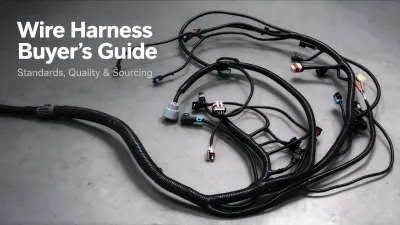
'Automotive harness' is really four or five different products wearing one name: the cabin loom, the engine bay harness, the chassis runs, the door circuits and — in new energy vehicles — the high-voltage system. Each zone attacks wiring differently, and a supplier who treats them identically builds in failures. This guide breaks down the zone-by-zone requirements that drive custom automotive harness design.
Cabin Zone: Density, Noise and Serviceability
The instrument panel and cabin harnesses carry the most circuits in the vehicle, in a space users see and touch. Priorities: circuit organization by branch, connector keying that prevents mis-mating, audio and display noise discipline (separation from blower and lighting circuits, clean ground returns), and flammability-rated materials. Serviceability matters here more than anywhere else — every module in the dashboard will be replaced at some point, and the harness should not make that a body-shop job.
Engine Bay: The Materials War
Engine zone harnesses fight heat, fluids and vibration simultaneously: cross-linked and silicone insulation by temperature zone, drip loops against fluid wicking, abrasion armor at every metal contact, positive-lock sealed connectors, and service loops at engine-body crossings. Failures here are expensive enough that material traceability and crimp documentation are standard requirements, not options. Our engine harness guide covers the zone in depth.
Chassis and Underbody: Impact and Exposure
Chassis runs see stone strike, road spray, salt and flexing where they cross suspension and steering motion. Constructions respond with abrasion-resistant sleeving (textile braid over convoluted tube in exposed areas), sealed connectors throughout, flex-rated cable at movement points, and routing that uses the body structure as armor rather than fighting exposure directly.
Door and Moving Circuits: Flex Life First
Doors, tailgates and mirrors add a flexing duty measured in tens of thousands of cycles: boot-protected flex sections, fine-strand constructions rated for the cycle count, and strain relief at both ends of every flex zone. Underestimating flex duty produces the classic door-harness intermittent that no bench test reproduces — our robot cable flex-life principles apply directly.
High-Voltage New Energy: A Different Product
EV high-voltage harnesses add a safety-critical layer: orange jackets per convention, shielding against the switching noise of drives and chargers, interlock loops that de-energize on separation, large-cross-section terminations whose quality is thermal-critical, and connector systems designed for service under HV safety rules. This is its own manufacturing discipline — separate tooling, test equipment and process documentation from low-voltage work. Our high-voltage harness guide covers the requirements.
The Supplier Implication
A supplier serving all automotive zones needs zone-specific materials knowledge, sealed and HV connector process capability, and documentation systems that satisfy program audits. Kaweei manufactures across cabin, engine, chassis and high-voltage constructions from our Dongguan facility. Contact our engineering team with your zone requirements — the earlier the zone map reaches us, the cheaper the program.