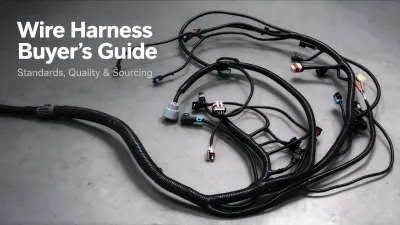
A motorcycle harness is an automotive harness compressed into a fraction of the space — wrapped around an engine that runs hotter than a car's, on a machine that vibrates harder and spends its life outdoors. Custom moto harnesses for builders, restorers and small-series manufacturers have their own design logic. This guide covers it.
Space and Routing: The Defining Constraint
Motorcycles leave no room for generous looms. Practical consequences: circuit minimization (every wire earns its place), compact connector families at the edges of the packaging, and routing that follows the frame with protection at every metal contact. The harness should be designed with the bike's actual geometry in hand — drawings from a different model produce a loom that fights the machine. Loops of slack are still needed at steering and suspension movement points; the art is hiding them inside the routing rather than omitting them.
Heat Zones
Air-cooled engines make the cylinder head area genuinely hot; exhaust routing adds radiant heat along the frame. Harness sections in these zones need high-temperature insulation (cross-linked or silicone), heat shields or standoff routing, and — critically — placement that accounts for heat soak after shutdown, when cooling airflow stops but stored heat radiates. Connectors near the engine should be temperature-rated housings, not commodity nylon.
Vibration: The Primary Killer
A motorcycle's vibration environment exceeds a car's, concentrated through the handlebars and frame. Harness responses: fine-strand conductors throughout (solid or coarse-strand wire fractures at terminations within seasons), positive-lock connectors everywhere, strain relief at every termination, and abrasion protection at every frame contact — a rubbing loom wears through insulation where nobody looks. Our connector failure analysis explains the wear mechanics that vibration drives.
Weatherproofing
Motos live outside. The harness needs sealed connectors or overmolded joints at every exposed point, drip loops so water never wicks into connectors, and UV-stable sleeving in sun-exposed runs. Headlight buckets and tail sections collect water — routing and connector placement must assume it.
Electrical System Considerations
Custom builders should size conductors for the real loads with margin for added accessories (heated grips, aux lights — the most common aftermarket overload), protect every circuit with fuses accessible without disassembly, and use a ground scheme that avoids chassis-return dependence on painted joints — dedicated ground wires to critical circuits prevent the intermittent electrical gremlins moto forums are full of. Our automotive wiring guide covers the fundamentals at system level.
Kaweei Motorcycle Harness Service
Kaweei builds custom motorcycle harnesses from customer routing data or existing-sample reverse engineering — compact looms, heat-zone rated sections, sealed connectors and full electrical test — supporting custom builders, restorers and small-series manufacturers. Contact us with your bike's details and electrical list; see also our motorcycle cable guides for specific assemblies.